Lean Beef is Heart and Gut Microbiome Friendly

The Average American Diet is the culprit!
Fact Checked
×All the content published in our website is fact checked to validate its accuracy.
Visit our guidelines web page to learn more about our strict processes regarding how we review our content's sources: reliable and reputable journals, media websites, universities, colleges, organizations, and professionals.
Our articles are based on scientific evidence, and the references are included in their footnotes, which are clickable links to sound scientific papers.
First published: February 15, 2026
Summary: Red Lean Meat with a Med Diet is good for Heart and Microbiome
A study published in the Journal of the American Heart Association(1) suggests that consuming lean beef in the context of a Mediterranean Diet, rich in plant-based foods such as vegetables, nuts, whole grain, fruits, and beans, and low in sugars, processed foods and refined carbohydrates, may increase diversity of the gut microbes, and at the same time, maintain low levels of trimethylamine N-oxide (TMAO), a metabolic compound linked to a higher cardiovascular risk.
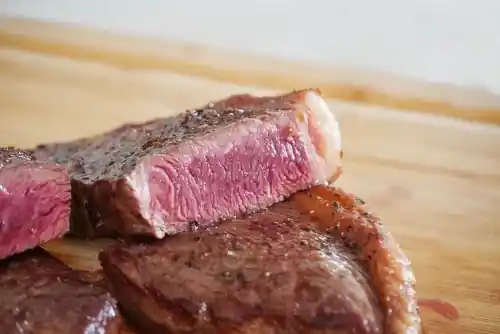
Lean Beef and the Mediterranean Diet
Red meat consumption has been linked to a higher risk of cardiovascular disease (CVD), and a key marker of CVD is a metabolite known as trimethylamine N-oxide (TMAO), which is produced by the body using precursors such as carnitine, found in beef. However, red meat is an excellent source of bioavailable heme iron and complete protein. These are essential to promote muscle growth and prevent anemia.
This study took 30 healthy, young adults, who followed four controlled diets for 4 weeks.
The participants consumed three Mediterranean-style diets (MED) with the following macros: 42% carbohydrates, 17% protein, and 41% fat. The difference between these diets was the quantity of lean beef consumed: 14 g (0.5 oz), 71 g (2.5 oz), and 156 g (5.5 oz) per day, corresponding to a 2000 kcal intake. They also followed a fourth diet, the Average American Diet (AAD), which consisted of 52% carbs, 15% protein, and 33% fat, including 71 g of beef per day.
Results
- All three MED diets increased gut microbiota diversity in comparison to the AAD.
- Blood levels of TMAO were roughly two-times higher after following the AAD compared to the two lowest beef intake MED diets.
- Urine levels of TMAO were between 1.76 and 2.15 times higher than those of the three MED diets.
What is Lean Beef
Lean beef or lean meat is any meat with less than 10 percent total fat, 4.5% saturated fat, and less than 95 mg. of cholesterol per 100 g (3.5 oz) cooked portion.
Key findings
- Mediterranean‐style diets containing 14 and 71 g per day of lean beef "lowered plasma and urinary trimethylamine N‐oxide concentrations compared with an average American diet with 71 g/ of beef"
- All diets, MED and AAD, were evidently healthy because "TMAO concentrations remained well below the clinical threshold for increased cardiovascular disease risk."
- "Gut microbiota diversity increased after the Mediterranean‐style diets and was not affected by beef dose, whereas substantial interindividual differences in trimethylamine N‐oxide concentrations were observed, regardless of diet."
In healthy individuals, moderate lean beef consumption as part of a Mediterranean‐style does not elevate trimethylamine N‐oxide to concentrations considered clinically relevant for cardiovascular disease risk. María Paula Jarr&iacjte;n-Orozco et al. (2026)(1)
Mechanisms and Conclusions
The gut microbiota consumes choline, carnitine, betaine, and phosphatidylcholine found mainly in animal foods such as fish, eggs, poultry, pork, and beef, and produces a metabolite called TMA or trimethylamine. The liver then oxidizes TMA into a compound called TMAO. Research using animals has shown that TMAO may be a factor that contributes to atherosclerosis and, therefore, heart disease by causing inflammation in the blood vessels and altering the cells that line them.
Interestingly, this study found that TMAO Concentrations did not differ between Mediterranean‐Style Diets with varying doses of Lean Beef, but were higher on an Average American Diet compared with a Mediterranean‐Style Diet with the same amount of beef. This would suggest that beef is not the culprit.
The scientific term is that urinary and plasma levels of TMAO are not dose-dependent with the amount of lean beef consumed in an MED diet.
Furthermore, the gut microbiota diversity (generally assumed as a factor that promotes good health) was higher in the subjects with the highest TMAO levels. This would suggest that diet, TMAO, and gut microbiota interact in a complex way.
The role of Fiber
The authors suggest that the higher fiber content in the Mediterranean diet (ranging from 23 to 26 g) in comparison to the 20 g for the Average American Diet could influence the bacterial output of TMA in the gut. It may promote the production of short-chain fatty acids (SCFAs) by the microbiome, which could modulate the amount of TMA available for oxidation in the liver. They caution that "More research is needed to elucidate fiber's role in gut microbiota modulation and TMAO metabolism within a MED diet."
The effect of a Healthy Diet
The study also points out that the microbiota in our guts depends on our diets, those who " habitually consume healthier dietary patterns may have different trimethylamine production from red meat" than those who follow less-healthy diets.
The Microbiome
The study showed that the output and, therefore, concentrations of TMAO in blood and urine vary considerably between individuals.
People consuming the same diet, with the same dietary precursors of TMAO, have different levels of TMAO.
The authors identified high-TMAO and low-TMAO producers and excreters (via urine). Interestingly, those who were high producers across all four diets "exhibited greater microbial diversity on average... This suggests that microbial metabolic activity, rather than diversity per se, may be more important in predicting TMAO metabolism"
Therefore, diet can have a significant effect on the production of TMAO, and it does so by changing the "microbial function rather than shifts in taxonomy".
Closing Comments
A healthy Mediterranean Diet with 71 g of lean beef (2.5 oz) per day does not hurt blood lipids or lipoproteins. It lowered blood and urinary TMAO levels when compared with the typical American diet with the same amount of beef.
Including up to 156 g (5.5 oz) per day in the context of a MED diet promotes gut microbiome structure, diversity, and health.
The American Heart Association guidelines recommend consuming fruits, vegetables, whole grains, legumes, nuts, and fish with small amounts of lean red meat (and no processed meats), which is in line with this study's findings.
The study involved young, healthy adults, so these outcomes may not apply to individuals with a higher risk for CVD.
Take Home Point
Adding lean red beef to a Mediterranean Diet will not worsen TMAO levels, and will provide heme iron, highly bioavailable protein, and maintain gut health.
References and Further Reading
(1) María Paula Jarr&iacjte;n-Orozco et al. (2026). Precision health targeting TMAO in postmenopausal women: polyphenol effects modulated by urolithin A and equol metabotypes in a randomised, placebo-controlled crossover trial.Food & Function. https://doi.org/10.1039/D5FO05461C
About this Article
TITLE, A. Whittall
©2019-2026 Fit-and-Well.com, 15 February. 2026. Update scheduled for 15 February. 2026. https://www.fit-and-well.com/health/lean-beef-heart-and-microbiome-friendly-Feb-15-2029.html
Tags: TMAO, Mediterranean Diet, heart, microbiome