Aspartame could be bad for your brain and heart
Aspartame impacts cognition and heart health

Fact Checked
×All the content published in our website is fact checked to validate its accuracy.
Visit our guidelines web page to learn more about our strict processes regarding how we review our content's sources: reliable and reputable journals, media websites, universities, colleges, organizations, and professionals.
Our articles are based on scientific evidence, and the references are included in its footnotes, which are clickable links to sound scientific papers.
First published: 26.Dec.2025
Overview
Spanish reserchers just published a paper in Biomedicine & Pharmacotherapy (Aspartame decreases fat deposits in mice at a cost of mild cardiac hypertrophy and reduced cognitive performance (1) reporting that mice, subjected to a diet with an intermittent intake of aspartame, with doses that were well below the Recommended Daily Allowance for humans, suffered negative cognitive effects as well as mild heart inflammation, scarring, and enlargement. These adverse side effects highlight the risks involved in consuming artificial sweeteners, even in small amounts. The upside is that, at least in mice, it promotes loss of body fat (a 20% drop in fat deposits) and suppresses appetite.
In this Article (Index)
- Aspartame: the sweetener
- Aspartame's Maximum Daily Allowance
- Aspartame: Cognitive and Cardiac Side Effects
- Lowers appetite and Body Fat
- Negative effects to the heart
- Brain: Cognitive Impairement
Aspartame: the sweetener
What is it?
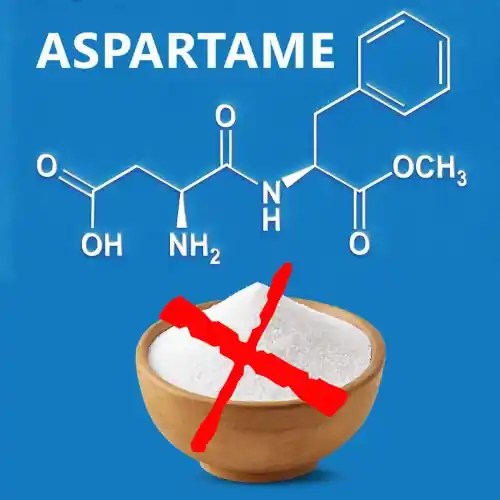
Aspartame is an artificial food sweetener, synthesized from two aminoacides, aspartic acid and L-phenylalanine, which are reacted in a process involving acetic acid and a palladium catalyst. The final product is a chemical known as L-aspartyl-L-phenylalanine methyl ester. The image above shows its molecular formula.
Apartame was a chance discovery that happened sixty-years ago, when James M. Schlatter, seeking a drug to prevent ulcers, stumbled apon this product which is nearly 200 times sweeter than sugar (sucrose).
It has almost zero calories which makes it an ideal artificial sweetener. However, since it is unstable when heated, losing its sweetening properties, it is only used in products that are not baked such as sodas, powdered fruit juices, gelatin, yougurt, sugar-free syrups, chewing gum, etc.
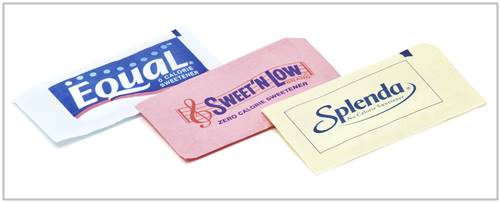
Some brand names for Aspartame are Nutrasweet®, Equal®, Canderel®, and Sugar Twin®
As it contains phenylalanine it should be labeled as not suitalbe for people with phenylketonuria (PKU), a genetic disorder that causes difficulty in metabolizing phenylalanine.
Maximum Daily Allowance
The limits set in the European Union by the European Safety Authority (EFSA) are 40 milligrams per kilogram of body weight (mg/kg). In America, the U.S. Food and Drug Administration (FDA) has set a slightly higher value, which is 50 mg/kg. The World Health Organization set the dose at 40 mg/kg.
Doses below the Maximum Recommended Dose can be harmful
The study that we mention further down administered doses well below the Maximum Daily Allowance, and even so, found harmful effects.
References and Further Reading
(1) Irati Aiestaran-Zelaia, et al. (2025), Aspartame decreases fat deposits in mice at a cost of mild cardiac hypertrophy and reduced cognitive performance. Biomedicine & Pharmacotherapy, Vol. 194, 2026, 118891, ISSN 0753-3322, https://doi.org/10.1016/j.biopha.2025.118891.
About this Article
Aspartame could be bad for your brain and heart, A. Whittall
©2025 Fit-and-Well.com. First Published: 26.Dec.2025. Update scheduled for 26.Dec.2028. https://www.fit-and-well.com/fitness/aspartame-bad-for-brain-and-heart.html
Tags: sweeteners, aspartame, heart, cognition, health, diet, weight, sugar